
Lithium ion batteries
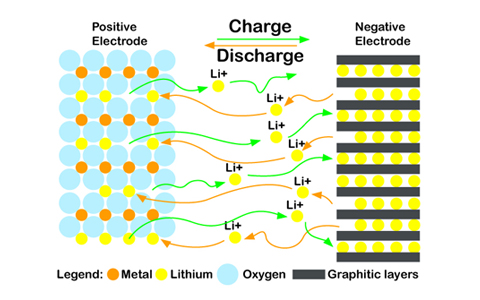
Lithium ion batteries are a type of rechargeable battery in which a lithium ion moves between the anode and cathode. The lithium ion moves from the anode to the cathode during discharge and from the cathode to the anode when charging. They are currently one of the most popular types of battery for portable electronics, with one of the best energy-to-weight ratios, no memory effect, and a slow loss of charge when not in use. In addition to uses for consumer electronics, lithium-ion batteries are growing in popularity for defense, automotive, and aerospace applications due to their high energy density. The three primary functional components of a lithium ion battery are the anode, cathode, and electrolyte, for which a variety of materials can be used. Commercially, the most popular material for the anode is graphite. The cathode is generally one of three materials: a layered oxide, such as lithium cobalt oxide, one based on a polyanion, such as lithium iron phosphate, or a spinel, such as lithium manganese oxide, although materials such as TiS2 (titanium disulfide) were originally used. Depending on the choice of material for the anode, cathode, and electrolyte the voltage, capacity, life, and safety of a lithium ion battery can change dramatically. Lithium ion batteries are not to be confused with lithium batteries, the key difference is that lithium batteries are primary batteries containing metallic lithium while lithium-ion batteries are secondary batteries containing an intercalation anode material.
The three participants
The three participants in the electrochemical reactions in a lithium ion battery are the anode, cathode, and electrolyte. Both the anode and cathode are materials into which and from which lithium can migrate. The process of lithium moving into the anode or cathode is referred to as insertion (or intercalation), and the reverse process, in which lithium moves out of the anode or cathode is referred to as extraction (or deintercalation). When a cell is discharging, the lithium is extracted from the anode and inserted into the cathode. When the cell is charging, the reverse process occurs: lithium is extracted from the cathode and inserted into the anode.
Improvements in lithium ion battery technology
Our research efforts are focused on several aspects of the Li-ion battery including nanostructured electrode materials, in-situ analysis and hybrid solar-battery. Increasing life cycle and performance (decreasing internal resistance and increasing output power) by changing the composition of the material used in the anode and cathode along with increasing the effective surface area of the electrodes. Improving capacity by improving the structure to incorporate more active materials. Improving the safety of Lithium Ion style batteries. In-situ & ex-situ analysis (XRD, Raman, IR, XPS) of electrochemical reaction mechanism.